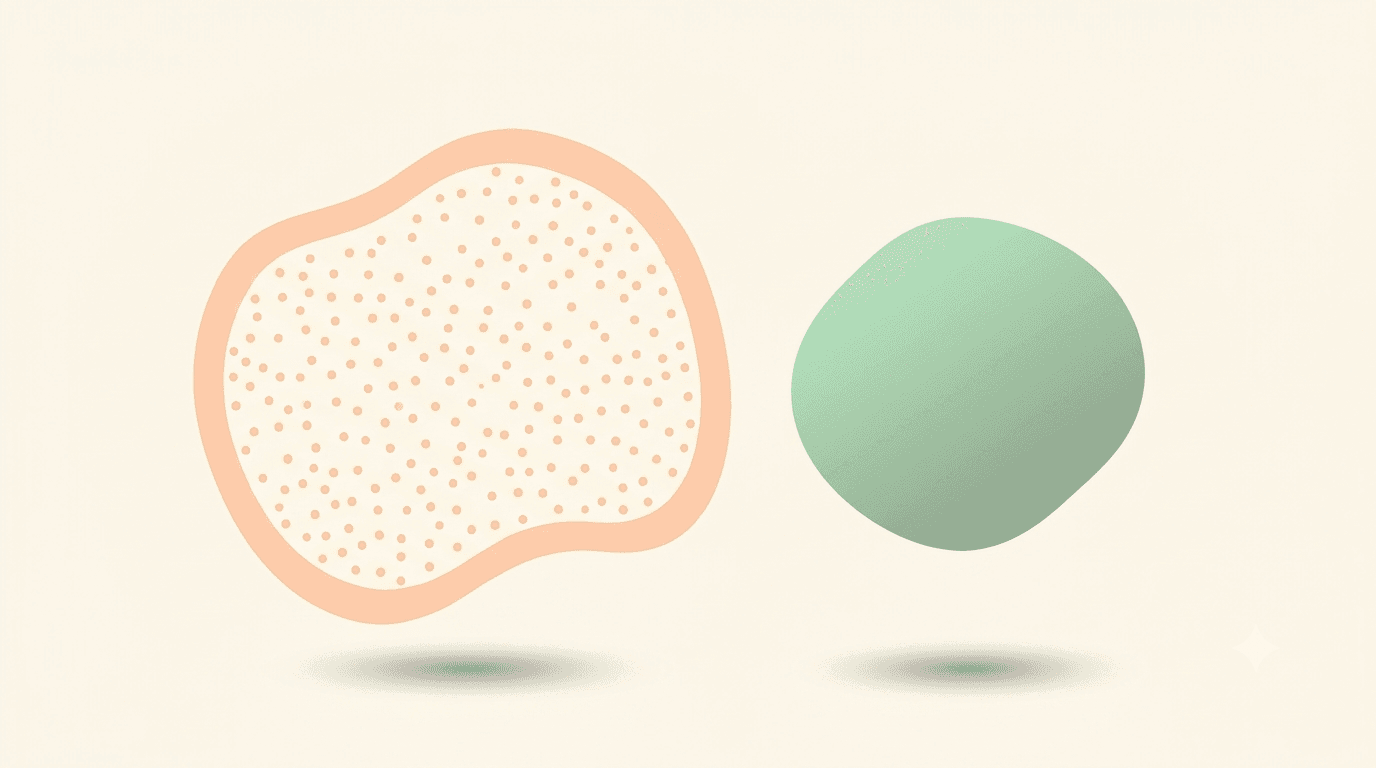
"Muscle weighs more than fat" is one of the most repeated lines in fitness, and it's not quite right. A kilogram is a kilogram, on a scale or anywhere else. What's actually true — and what the phrase is reaching for — is that muscle is denser than fat, so equal weights of each take up different amounts of space.
The short answer
- A pound of muscle and a pound of fat weigh the same. Mass doesn't change based on what tissue it is.
- Muscle is denser. Using standard reference values, fat is about 0.900 g/cm³ and fat-free mass (mostly muscle) is about 1.100 g/cm³.
- That density difference means a kilogram of fat takes up roughly 22% more volume than a kilogram of muscle.
- This is why your body can look visibly different — smaller, more defined — at a nearly unchanged number on the scale, if you're gaining muscle and losing fat at similar rates.
The actual physics: same mass, different volume
Density is mass divided by volume. Two materials can weigh exactly the same and still take up very different amounts of space if their densities differ — a kilogram of feathers and a kilogram of lead are both, unambiguously, a kilogram.
For body tissue, the reference values used across body composition science come from a classic 1963 analysis: fat has a density around 0.900 g/cm³, and fat-free mass (bone, muscle, organs, water — mostly muscle in practical terms) is around 1.100 g/cm³ (reference). Do the arithmetic on those two numbers and a kilogram of fat occupies about 1,111 cm³, while a kilogram of fat-free mass occupies about 909 cm³ — roughly 22% more volume for the same mass.
That's the entire mechanism. Nothing about muscle makes a given amount of it heavier. It's simply packed more tightly.
Worth knowing: these reference numbers have a history
The 0.900 / 1.100 figures are useful and widely used, but they're not universal physical constants measured on every body — they trace back to a specific, small, and specific reference study. The values "are used in the calculations (Brozek et al., 1963)," and they were derived from "cadaver analyses, which form the basis for the 'reference man'" (Methodologies for Measuring Body Composition in Humans). The "reference man" cadaver work behind fat-free mass density specifically involved a small number of adult men.
The same source is direct about the limitation: "there is an increasing realization that it is invalid to assume the chemical constancy of FFM... thus, the value of 1.095 for the density of FFM... must be used cautiously." Fat-free mass density genuinely varies by life stage — it's cited as low as 1.064 in infants versus 1.095 for the adult reference man. Body fat density is more stable across individuals, reported to vary by less than about 2%.
None of this changes the basic point — muscle is meaningfully denser than fat, reliably enough that the 22% figure is a reasonable working number. It's worth knowing the number isn't derived from measuring your specific body, the same way an InBody or DEXA reading is a population-level estimate applied to an individual, not a bespoke measurement of you.
Why this explains a stalled scale that isn't actually stalled
This is where the myth stops being trivia and starts being useful. If you're strength training while eating close to maintenance, or during a slow recomposition phase, it's entirely possible to gain a meaningful amount of muscle while losing a similar amount of fat. Total mass barely moves. The scale looks stuck.
But you gained denser tissue and lost less-dense tissue in roughly equal amounts of weight — which means your total volume went down even though your total mass didn't. That's a real, physically explainable reason your waistband can feel looser, your progress photos can look different, and your tape measurements can shift, all while the number on the scale stays almost exactly where it was. It's one of the clearer physical mechanisms behind what's often described as a non-scale sign of recomposition — this one just happens to have a clean physics explanation rather than being purely a measurement-noise story.
This is also what "toning" is actually describing
"Toning" gets used loosely, but the density explanation is usually what people mean by it, whether they realize it or not. A body that looks more defined and compact at a similar weight isn't the result of muscle "toning up" into a different substance — it's the combination of some fat loss and some muscle gain, changing volume and shape at a mass the scale barely registers as different.
There's no tissue-level process that makes existing muscle firmer without changing its mass or the fat around it. What changes the visible shape is the ratio of two tissues with different densities shifting — which is exactly the mechanism above, just under a vaguer name.
Bottom line
Muscle doesn't weigh more than fat — equal amounts of each weigh the same, always. What's true is that muscle is denser, so it takes up meaningfully less space, roughly 22% less by volume for the same mass using standard reference values. That's a real, physical reason your body can visibly recompose while the scale holds still — not a trick of perception, and not the scale lying to you. It's measuring exactly what it's built to measure: mass, not volume, and not shape.